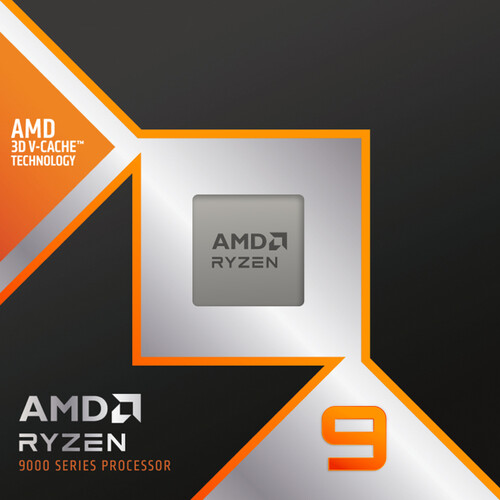
The 9950X3D vs 9800X3D decision comes down to one question: is your PC only for games, or does it also render, encode and compile? Both chips use AMD’s 2nd-gen 3D V-Cache on the AM5 socket, but one is an 8-core gaming specialist and the other is a 16-core processor built to do a bit of everything.
Below, our build team compares the specs, the cache layout, gaming and creator strengths, power and cooling, and total platform cost, then gives a clear pick for each kind of buyer.
In This Guide
9950X3D vs 9800X3D: Specs Side by Side
Here’s the full 9950X3D vs 9800X3D spec sheet, taken from AMD’s official product pages for the 9950X3D and the 9800X3D.
| Spec | 9950X3D | 9800X3D |
|---|---|---|
| Architecture / socket | Zen 5 / AM5 | Zen 5 / AM5 |
| Cores / threads | 16 / 32 | 8 / 16 |
| Base / max boost | 4.3 / 5.7 GHz | 4.7 / 5.2 GHz |
| L2 cache | 16 MB | 8 MB |
| L3 cache | 128 MB | 96 MB |
| 3D V-Cache | On one of two CCDs | On its single CCD |
| Default TDP | 170 W | 120 W |
| Max temp (Tjmax) | 95°C | 95°C |
| Official memory (two DIMMs) | DDR5-5600 | DDR5-5600 |
| Cooler in the box | None | None |
| Launch | March 12, 2025 at $699 | November 7, 2024 at $479 |
In plain terms, the 9950X3D gives you twice the cores and threads, twice the L2 cache, 32 MB more L3 and a 500 MHz higher max boost. The 9800X3D answers with a 400 MHz higher base clock, a 50 W lower default TDP and a launch price that was $220 lower.
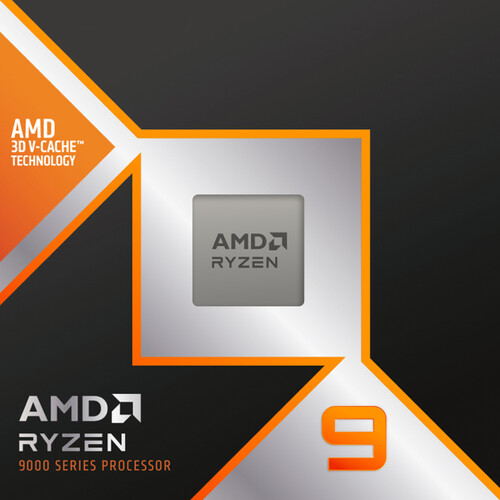
Cache Layout: One CCD or Two
The most important technical difference isn’t the core count. It’s where the stacked cache lives. Ryzen 9000 desktop chips are built from chiplets: an I/O die plus one or two CCDs (core complex dies) that hold the cores. AMD’s spec pages list two package dies for the 8-core chip and three for the 16-core chip.
- 9800X3D: one CCD with all eight cores, and the 3D V-Cache sits underneath them. Every core has the big cache, so there’s nothing to manage.
- 9950X3D: two eight-core CCDs, with 3D V-Cache on only one of them. Eight cores get the stacked cache, and the other eight don’t.
That split explains most of the 9950X3D vs 9800X3D story. The cache-equipped CCD is there for games, while the second CCD adds raw multi-threaded muscle for creative work. Because a game’s threads ideally stay on the cache CCD, keep your BIOS, AMD chipset drivers and Windows up to date if you choose the dual-CCD chip.
9950X3D vs 9800X3D for Gaming
For a gaming-only PC, the 9950X3D vs 9800X3D comparison is less dramatic than the spec sheet suggests. Both chips have eight cores on a 3D V-Cache die, and that’s the part games lean on. The second CCD on the 9950X3D mostly sits outside the gaming picture.
AMD’s own positioning reflects that. It describes the 9800X3D as a way to “harness the ultimate gaming edge,” while it pitches the 9950X3D as “the ultimate 16-core desktop CPU” for “the most demanding gamers and creators.” In other words, AMD sells one as the gaming chip and the other as the do-everything chip.
A few practical points for gamers:
- Resolution matters. At 4K the graphics card does most of the work, so even the gap between strong CPUs shrinks further.
- Simplicity has value. With a single CCD, the 9800X3D never has to steer a game toward the right set of cores.
- Budget goes further elsewhere. The $220 launch price gap in a 9950X3D vs 9800X3D build can go toward a better graphics card, which usually does more for frame rates.
Creator Work: Where 16 Cores Pull Ahead
Switch from gaming to rendering, and the picture flips. Tasks that split work across many threads, such as 3D rendering, video exports, code compiling, shader builds and running virtual machines, scale with core count. This is where the 9950X3D vs 9800X3D comparison swings the other way: the 16-core chip has twice the cores and threads, plus double the L2 cache.
That’s why we steer gamers who also create toward the bigger chip in the 9800X3D vs 9950X3D debate. If you spend real time waiting on renders or exports, the extra cores pay you back every day. If you edit the occasional clip, the 8-core chip with a modern GPU handles it fine.
Streaming is a special case. With GPU encoding, such as NVIDIA NVENC or AMD AMF in OBS Studio, the encode work moves to the graphics card instead of the CPU. For a dedicated streaming PC, that means the 8-core chip is often enough, unless you also edit and render your VODs.
Power, Heat and Cooling
Power is another clear 9950X3D vs 9800X3D difference: a 170 W default TDP against 120 W. Both share a 95°C Tjmax, neither ships with a cooler, and AMD says a liquid cooler is recommended for optimal performance on both.
Our advice for the 9950X3D vs 9800X3D cooling question:
- 9800X3D: a good 240mm or 360mm AIO cooler is a comfortable match.
- 9950X3D: go straight to a 360mm AIO, since it has the higher default TDP and long all-core jobs keep it working hard.
- Power supply: the 50 W TDP gap is small next to a modern graphics card. NVIDIA rates the RTX 5090 at 575 W total graphics power, so size your PSU for the GPU first.
Price and Platform Costs
On price, the 9950X3D vs 9800X3D gap was $220 at launch: $699 against $479. Check our product pages for current prices, since CPU pricing moves over a product’s life.
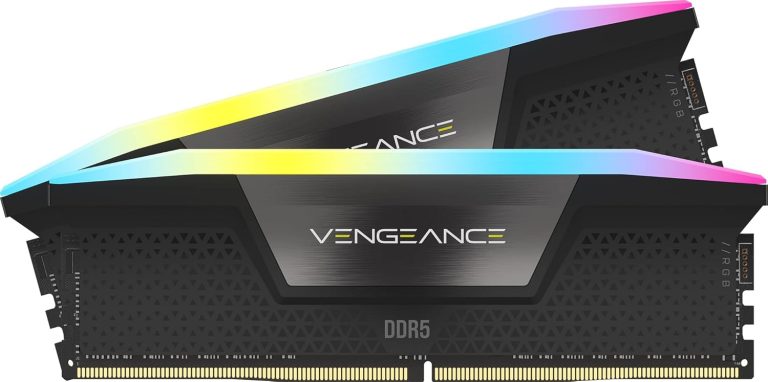
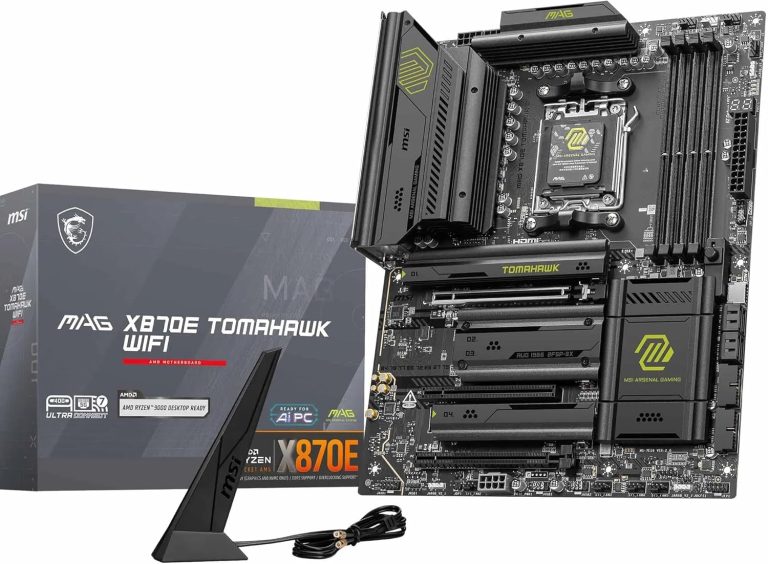
Everything else on the platform is shared. Both chips drop into the same AM5 boards, from A620 up to X870E, and both use dual-channel DDR5. That makes memory the other big line item in 2026. A global DRAM shortage driven by AI data-center demand has pushed RAM street prices far above where they were, and at the time of writing a 32 GB DDR5-6000 kit runs roughly $500 to $650 at US retail. In many builds, the RAM now costs about as much as the CPU.
What About the 9950X3D2 and 9850X3D?
Two newer chips complicate the 9950X3D vs 9800X3D choice in useful ways:
- Ryzen 9 9950X3D2 Dual Edition (April 22, 2026): the first desktop chip with 3D V-Cache on both CCDs, for 192 MB of L3. It keeps 16 cores and 32 threads, carries a 200 W default TDP and reportedly launched at $899. It removes the one-cache-CCD compromise, at a price. Our LUX HAF II 500 9950X3D2 RTX 5090 is built around it.
- Ryzen 7 9850X3D (January 29, 2026): a higher-binned 8-core chip with a 5.6 GHz boost, 400 MHz above the 9800X3D, at $499 launch pricing. Our 9850X3D vs 9800X3D breakdown explains how small that step is.
- Ryzen 9 9900X3D (March 12, 2025): a 12-core middle ground with 128 MB of L3 and a 120 W TDP, at $599.
AMD Ryzen 9 9950X3D
The AMD Ryzen 9 9950X3D is a desktop processor with 16 cores and boost speeds up…
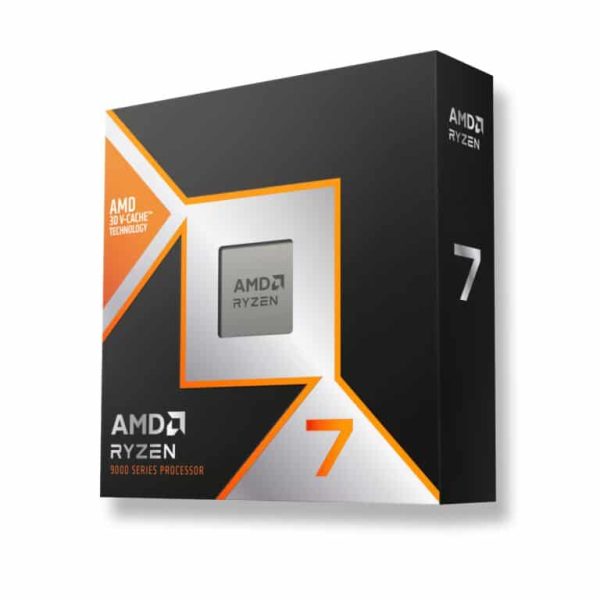
AMD Ryzen 7 9800X3D
The AMD Ryzen 7 9800X3D is a desktop processor with 8 cores and boost speeds up…
AMD Ryzen 9 9950X3D2 Dual Edition Desktop Processor
The AMD Ryzen 9 9950X3D2 Dual Edition Desktop is a desktop processor, built for high frame…
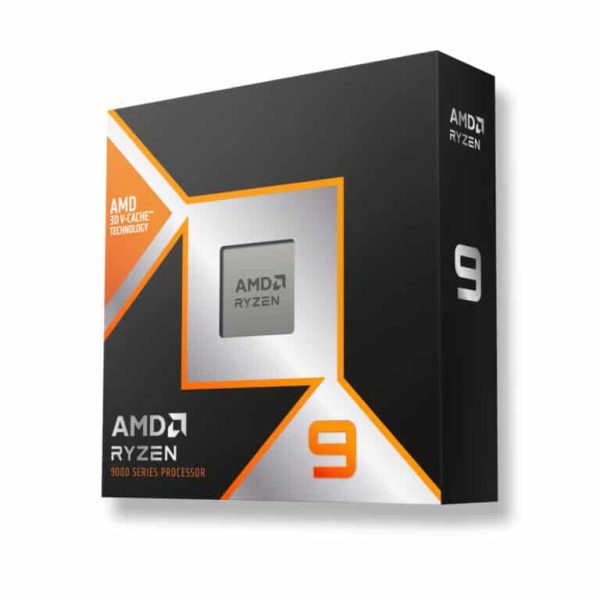
AMD Ryzen 9 9900X3D
The AMD Ryzen 9 9900X3D is a desktop processor with 12 cores, built for high frame…
9950X3D vs 9800X3D FAQ
Is the 9950X3D better than the 9800X3D for gaming?
Not in a way that justifies the price for a gaming-only PC. Both chips have eight cores sitting on a 3D V-Cache die, which is what games lean on. The 9950X3D’s extra eight cores help mostly in multi-threaded creative work, so gamers get better value from the 9800X3D.
9800X3D vs 9950X3D: which is better for streaming?
If you stream with GPU encoding in OBS Studio, the 9800X3D is usually plenty. If you also edit, render or encode long videos on the same PC, the 9950X3D’s 16 cores make the 9800X3D vs 9950X3D choice easy in its favor.
Do both chips use the same motherboard and RAM?
Yes, so the 9800X3D vs 9950X3D choice doesn’t change your board or memory plan. Both are AM5 processors with support from A620 through X870E, and both use dual-channel DDR5 with DDR5-5600 listed as official for two DIMMs. Older 600-series boards may need a BIOS update first.
Does the 9950X3D need a bigger cooler?
It has a 170 W default TDP versus 120 W, and AMD recommends liquid cooling for both. We suggest a 360mm AIO for the 16-core chip so it can hold boost clocks during long all-core workloads.
Is the 9950X3D overkill for a gaming PC?
For gaming alone, usually yes. In the 9950X3D vs 9800X3D matchup, the extra cores only earn their keep if you also create, compile or run heavy multitasking.
Which Should You Choose?
The 9950X3D vs 9800X3D verdict is simple. Pick the 9800X3D if your PC is for gaming. It’s simpler, cooler, cheaper and has the full 3D V-Cache advantage on every core. Pick the Ryzen 9 9950X3D if you game and create, because the second CCD turns waiting time into working time. And if you want both CCDs cached and the budget allows, the 9950X3D2 Dual Edition is the no-compromise option. For a deeper look at the 8-core chip, see our Ryzen 7 9800X3D guide.
Compare current prices in our CPU collection, or let us build it for you. Every Luxvibe PC is hand-built to order, and upgrades and changes are always possible before we build. Still deciding? Real builders answer questions through our contact page or at sales@luxvibepcs.com.